Friday, March 21, 2014

Safari Excitement

Pictures coming soon
Jason and I were nuclear explosions of excitement radiating adrenaline at nine a.m. Monday morning, February 10th. After what felt like months of waiting -which it was- we were finally going to go on a hunting safari in Namibia, alone! No parents for a week. Just us, our professional hunter (PH) Yakub, Francis our tracker, the cook Anita, and the safari farm's owner Tinus. 

My mom had to work down in a place called Tsumeb for the week, which left my brother and I with nothing to do for several days except sit in a hotel room. But after a brilliant idea, and a couple phone calls, we found Osonjiva Hunting Safaris. They were perfectly OK with letting two kids come and stay alone for the week, and would provide us with hunting rifles and shooting lessons. 

A white van drove up to the hotel lobby. It was covered with thick mud- due to the massive downpour that had started around 7 and hadn't yielded yet- and on the side door a sun-faded sticker read 'Osonjiva Hunting Safaris.' The driver stepped out and introduced himself to us as Yakub (pronounced Yak-oob), our PH for the week. He was a tall, burly German with short red hair and mustache, and light blue eyes. Despite the cold weather, he had on shorts and a button up short sleeved shirt. Yakub reassured my mom that he would take good care of us, and helped load our luggage into the back of the van.

After we said our goodbyes to my mom, it was off to the gun shop to pick up ammo for the .308 Winchester we would be using to shoot throughout the week. Yakub told us that the rifle was his, and that if aimed into the ear, it could even kill an elephant. This led to my little brother asking A LOT of gun related questions...

Our second stop was the taxidermist. I had never been to one before, but it's impressive to see. The van pulled up to a huge warehouse, and Yakub led us inside so we could see the process of how they really make the trophy heads, and get a price list so that if we wanted trophies to be made of our kills, we'd have an idea of pricing. Inside, the warehouse walls were lined to the roof with trophy heads of every animal imaginable. There were racks to hold more of the finished trophies on the ground, and taxidermists were busy sculpting full body mounts of every shape and size. 

After looking around some more, we got back in the car. This time joined by our cook Anita, the owner Tinus, and Tinus' dog, Mango. From there we headed to the Game Lodge, driving far away from town on dirt road. The rain had finally stopped, but when it rains in Africa, it floods. So the supposed-to-be 45 minute drive became an hour and a half.

When we finally arrived everyone was starving, and Anita whipped together one of the best lunches I've ever had. Yakub said we could go out for shooting lessons after we put our stuff away. Usually unpacking takes a while, but we shoved our stuff in the closet in record time.

An olive green pick up truck was waiting for us outside when we were done. Yakub was carrying two rifles over to it. Our .308 Winchester, which had a scope and a silencer screwed on the front, and a .458 with iron sights for any leopards we might run into. He told us to hop into the back with Francis, our tracker for the week. 

We drove out of the lodge and past the herds of cows the lodge used for fresh milk and meat, arriving at a large gate that separated the game farm from the rest of the area. Francis jumped out and opened it up so we could drive through, and then jumped back on. We drove through the bush for a while until we came upon an open area with termite mounds in the distance.

 The pick up stopped at a "shooters table" and everyone got out. Francis picked up a cardboard box from the back and walked it out to the termite mounds, when he placed it down, we realized there was a target taped to it. 

"You will shoot from ninety meters," Yakub explained, "This is the usual distance from which you will also shoot while we are hunting."

Yakub sat down at the "shooters table" and positioned the .308 on the shooting bag, telling us he just had to adjust the scope. Upon asking if we needed ear protection, Yakub told my little brother that he could cover his ears if he wanted, but that most people didn't care to out here, since the sound wouldnt be deafening. 

After a few shots had gone off we both agreed that the sound wasn't bad at all. It didn't take long before Yakub offered us the chance to shoot. My first shots were pretty decent, and Yakub said that on a big animal, a couple inches off wouldn't make a difference. 

It began to rain heavily after that, and since rain isn't good for rifles, we ended up heading back to the lodge. Thankfully the weather cleared up soon after, and Jason was able to shoot as we'll. By then it was about 4 in the afternoon, and Yakub told us that we still had plenty of time before dinner, which would be around 8. So we began hunting!

The first day we spotted plenty of animals: ------. I had decided to shoot Gemsbok/Oryx, while Jason was still making a hard decision between Blue Wildebeest and Warthog. 

At Osonjiva, Jackals and Baboons are free to shoot; they cause trouble in the farm, so if any are spotted, they'll be shot on sight. We spotted a Jackal while we were out, and Yakub got out immediately. He whispered to Jason that he should take the shot, and we began to crawl towards it quietly, taking cover behind a small termite mound. Yakub placed the rifle on his shoulder and steadied it with his hand, then beckoned Jason to come take a shot. But before Jason could look down the scope, the Jackal made a sound quite like the comedic kissing noise you hear on tv. Which meant that it saw us, but it was unsure about what we were. 

Yakub cupped his fist to his mouth and responded with the same noise. The Jackal drew closer. Curious.
 
Once again the Jackal and Yakub called out to one another, the Jackal again drawing nearer. It was facing straight towards us now.

"Take the shot where the neck and chest meet," Yakub whispered.

BLAM! The Jackal fell over from the shot, but was up again instantly and took off running towards the bush. We ran over to where the jackal had been standing to find red coloring the dirt. Jason had shot the jackal high in the neck, and a couple inches to the left. 

Francis rumbled over in the truck, and we began to track. Jackals are small, light animals, so following their tracks in the dirt is quite useless. You can only follow them as long as there is blood. We ended up losing the trail, and our adrenalin slowly lost affect as well.

It wasn't until about six thirty that we finally spotted some Oryx and Blue Wildebeest. They were a good 1 1/2 kilometers away from the pick up, and hadn't noticed us. Yakub jumped out of the car and grabbed the .308, beckoning to us silently to get out as well. We began stalking in a single file line, weaving through the bush, slowly drawing nearer to the animals. 

The closer we came, the quieter our footsteps fell. A light rain had begun to fall as it got darker, and as we finally came close enough to take a shot, the sun had disappeared behind the horizon. Yakub set up the shooting sticks quietly, as neither the Oryx nor the Wildebeest had taken notice to us yet.

This time it was my turn. I watched the Oryx through my scope, but Yakub told me not to shoot yet, as right behind it was a wildebeest. Neither moved, meaning there was no clear shot. Then suddenly Yakub whispered for me to take the second wildebeest off to the right, which was facing forwards towards us about 70 meters away. He quickly explained that it would just be for meat.

I shot a bit to the left on the neck. The wildebeest fell over and stood up, stunned. Yakub took the rifle and tried to shoot again, but the rifle was jammed! Suddenly everything felt frantic. Yakub had to slam the rifle on the ground to remove the live round that was stuck, and ended up firing the rifle!! It spooked the Oryx and Wildebeest. With the pounding of hooves they raced deep into the bush.

Tracking was useless, as it began to get darker and darker. In Namibia, it is only legal to hunt until sunset, and our time was almost up. We could only pray that raid didn't cover up the tracks as Francis drove up in the pick up and we had to call it a day.


Friday, February 7, 2014

Visiting the Himba

**pictures coming soon**
One of the last indigenous people, Himba are very proud of their culture which has survived wars. Meeting them was a unique experience I won't forget.

To actually communicate with the Himba, we had to get a guide who could speak Herero, their language. Our guide turned out to be a former Himba herself who went to school and learned English. The tribe we visited was her own, and our experience went something like this:

7:30 am We woke up early and drove to the market to meet our guide/translator, since we had to drive her to the tribe. While at the market, we picked up bread, oil, and maize to give as a gift to the tribe. Our guide, Queen Elizabeth, said this was a customary procedure for visitors.

8:00 am After paying for our gifts, we drove for about thirty minutes along a gravel dirt road, leaving houses behind and replacing the city with spaced out clusters of mud huts. Most of these small villages were empty, as the Himba are still semi-nomadic. But the one Queen instructed us to drive up to was full of people.

The Himba villages are made up mostly of women. In fact, upon first look, that seems to be the only people there! We walked up to a small mud hut where an older woman was sitting and watching over the porridge bubbling in a large, black iron pot. We greeted her and gave her the gifts we had bought. She introduced herself as... well... I have no idea how to spell her name at all.

The older woman called the rest of the tribe over to us, and suddenly we were surrounded with women and children. The air smelled strongly of ochre, which is the red paste Himba women apply to their skin for sun protection. We introduced ourselves to everyone, and they had a good laugh teaching us how to say hello in Herero.

Queen told us we could take pictures as much as we wanted, so we snapped a couple group photos with all the Himba children. I also became a big point of interest, because they hadn't seen hair like mine before. The girls especially enjoyed to touch it, and tried to teach me how to say "hair" in Herero.

We were then led over to a grinding rock. My family was led by Queen, while I was led by both hands by the village children. One of the older girls showed us how they ground up barley for porridge with the stone, and then we were urged to try it. There is something very funny about watching a foreigner try out grinding, for all the children were giggling by the end. Even Queen thought it was amusing.

After that, the chief of the tribe came over and introduced himself to us, shaking each of our hands with his in turn. Queen explained why there weren't many men in the villages: most were down in town, drinking beer. But the chief usually stayed in the village, as it was his responsibility to make sure the tribe had enough to eat. He had several wives as well.

From there the kids led us to the main hut, where the chief usually stayed. It was mud, like the others, but inside the small hut was decorated quite thoroughly. There were mats of cow hides on the dirt floor, piles of maize flower given to the tribe by the Namibian government, and trinkets hung from the ceiling and walls, some of which were broken walkie talkies, a radio and a dirt covered cell phone.

A Himba woman was inside, and had the small fire pit going. Queen explained that the women would burn sage and use it as a natural cologne, since there was very little water here. The Himba woman showed us, squatting over the embers and fanning herself with the scent just like splashing water on yourself during a shower.

The woman then proceeded to rub herself with a mixture of Vaseline and ochre. The red ochre clay has a unique smell to it. Very earthy, and muddy. Queen told us the women do this multiple times as a daily ritual. The Himba woman then asked Queen something in Herero, which made her smile and chuckle to herself. We were asked if we'd like to try some of the mixture as well. I had thought we had gotten a laugh out of grinding...

The woman rubbed the ochre all over my face, which felt like a thick, grainy cream. She finished, and took a step back, saying -to my surprise- in English, "You are Himba now." She smiled, and I thanked her, turning towards everyone else. The hut was filled with laughter at my changed appearance, and no one else in my family opted for a Himba makeover. I sat back down amongst the Himba children who giggled and took some of the ochre from my face and rubbed it on their arms. They giggled and played with my hair and the buttons on my shirt, holding my hands with theirs.

Queen and the other Himba talked in Herero. I figured they knew each other, as Queen had lived here before moving into the city. One of the kids began to clap, and upon my joining in, the others did as well.

Then the Himba  children got up and performed a little dance. They stomped their feet excitedly and clapped their hands, making themselves a beat, then added in singing, which I cant exactly describe since the sounds were so foreign I'm not sure if they have a spelling, and one by one got up and danced in the small hut. It was a unique sight to see, and hear!

11:30 am We were then led out to the final stop of our Himba experience. While we had been busy learning about the culture, some of the women had set up a display of necklaces and other trinkets to sell us. Queen told us everything -bracelets, anklets, necklaces, drums, dolls, to name a few- were all handmade by the women and girls. We bought a few items, and Queen bargained a bit to get us a discount. Then we said our farewells, heading back to the car still surrounded with the curious village children. When we opened our doors, the kids took an interest to the empty water bottles laying on the floor. Queen asked if we would donate them, which we agreed, as the entire bottom floor of the car and back of the trunk were littered with them. The Himba people used them for multiple things. Most importantly was baby feeding.

12:00 Upon emptying our car of plastic treasures, we said our final farewell and left back to the city, dropping Queen off back at the market. All of us were still excited with our experience of a unique culture, and it was the topic of discussion for most of the drive back home.

Thursday, February 6, 2014

Mario Bros. Meets Africa


My mom recently took a trip up to Tsumeb, and came back with the biggest mushroom ever. It reminded me of the giant mushrooms from Mario Bros. The top part was the bigger than my face, and the stem was as big as my forearm! These monsters grow on the sides of the termite mounds, and are considered a delicacy in Namibia. People sell them on the side of the roads and restaurants supposedly buy up as many as they can.
 Well, I tried them, thinking they'd be good. But not so much. The whole boiled mushroom looked like a squid, and it had this nasty, slimy texture. Again, like a squid. I'm not a fan of squid at all. So my final review is yuck. :P
 
Just in case you're curious as how to prepare a giant mushroom, or you happen to find someone selling them along the side of the road since their in season, here's the recipe:
Ingredients:
1 giant African mushroom, with the black/brown spots on top scraped off
1 cup hot water
1/2 tbsp. olive oil
Instructions:
1. Put  water and oil into a pan on medium high heat. Place mushroom, stem and all, face down into the pan.
2. Boil until mushroom is easily pierced through with a fork.
3. Serve with more olive oil for dipping and salt+pepper for taste.

Friday, January 24, 2014

Kwashiorkor and Marasmus Put into Perspective

This past week my mom attended a meeting, and a part of it was a lecture about malnourishment. She brought back samples of the food supplements they give children with kwashiorkor or marasmus, and we got to try them.
For those of you who don't know, kwashiorkor is a version of malnutrition where a person doesn't get enough protein in their diet. They may be eating, but not a balanced diet, resulting in enlarged livers, and protruding stomachs, to name a few side effects. The supplement is called Plumpy Nut. 
It's quite close to the peanut butter they put in power bars. It's full of protein to help families and induviduals with kwashiorkor, and the lecturer said that 'it tastes so good, they'll give it to the children, and the adults will eat it too!'
Sadly kwashiorkor occurs in the villages here in the North. There is a lack of education and variety of foods available to the people up there. :(

Marasmus is different than Kwashiorkor. People with marasmus have not gotten any nutrition at all. They will get extremely thin, and lose muscle. The supplement is a pap (porridge).

The porridge supplement tasted like bread, and actually wasn't that bad, despite what I was told. Much of the cases of marasmus are also in the villages up North here in Namibia. It's tragic to think that 30% of the children here in Africa are malnourished, but hopefully these supplements will help improve the lives of millions!


Thursday, January 9, 2014

Swakopmund: Surf and Camel Turf

No trip to a beach town is complete without a surf trip! Everyone on the water was really friendly, and I got close to yet another seal. There was a decent reef break that got a bit too close to bare rock for comfort (If you don't know: a reef break is when waves will break over a reef that has rock on the bottom of the ocean floor instead of the usual sand). After surfing for a good three hours -and catching up on my tan- we headed to a great restaurant with a spectacular panoramic view of the ocean and massive dunes.


Camels might be some of the most dramatic creatures I've ever ridden. Whenever you mounted or dismounted, they would groan loud and long, kind of like an old man getting up in the morning. The morning before we left to go back to the north, my parents decided we would go on a last minute camel ride. And it was a bumpy experience! Camels have the same gait as horses, but their huge size makes every step feel like a jerky roller coaster that could use a breath mint. The rumors about camels having a lot of saliva is true. I didn't get spit on -sorry for those of you disappointed ;) - but others did.
<I cannot add pictures due to a bug in the blogger system>

Saturday, January 4, 2014

Season's Greetings


⭐Happy Holidays to everyone back home! Hope the new year is a great one!⭐

Swakopmund: Sea Lions and Quad Biking


It's winter time, which means it's time to bundle up with a good book and some cocoa and sit by the fireplace. Or you can do as the  Namibian natives do, and head to Swakopmund for the holidays!
This year, my family skipped the presents and drove for two days down to a German beach town to spend our Christmas by the ocean. After you live right next to the beach your whole life, and then suddenly move to an area where there aren't even lakes to swim in, it's not easy to take no for an answer
Our first sight in Swakopmund is one I like to call the sass-ful sea lion. The beach was abandoned at the time, since there was a freezing cold marine layer covering the shore.
Everyone gone except the seal lion and my camera! By far my favorite picture ever!

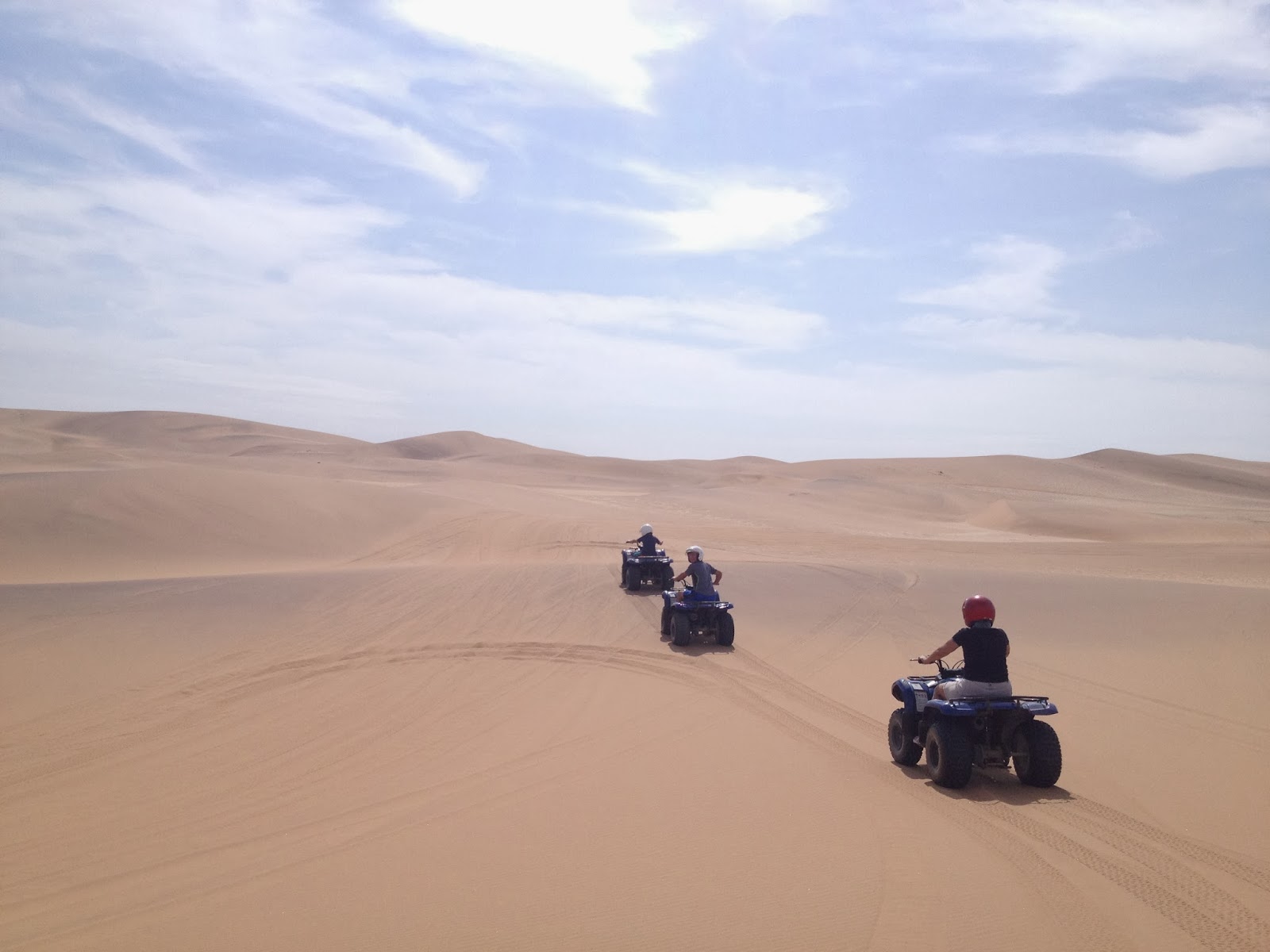
 On the first day of our stay here, we went Quad Biking through the enormous dunes of the African desert. It was an experience that combined the rush of adrenaline and adventure with desert wildlife. Imagine gunning it up the side if a dune the size of a five story building, and then turning sharply to speed back down it... and yelling like a crazy person despite yourself! Your heart leaps into your throat for a second and your stomach must have left you back at the top!

But if that doesn't have you psyched, seeing one of the deadliest snakes in Africa will! Our guide could find any creature just by the unique tracks it left in the sand. We saw a lot of crazy stuff, but the Sidewinder was by far the most intriguing. Our guide, Johannes, had stopped at a small cluster of plants that had managed to survive in the harsh, ever-changing conditions of the desert, and smiled, "Snake," he told us simply, using his walkie talkie to move it onto the large dune above us. A small, brown and tan snake glared at us. When Johannes tried to move it once more for a better camera view, it moved diagonally across the dune towards the sandy floor in a way that gave the Sidewinder it's name.

Unlike a normal snake, which usually uses its entire body to slither forwards across a surface, the Sidewinder moves sideways, winding its body in a backwards and forwards S shape so it only has to touch two parts of its body to the hot desert at any time. they are extremely venomous, so if one of us got bit out here, we probably wouldn't survive. But the only thing I took away from that lesson was that it looked like the Sesame Street show character, Cookie Monster, would have a hard time dealing trying to munch on this tough S-shaped cookie!

 When it had arrived on the floor, Johannes told us he would pick it up. It was a unique process of holding its head down with a tyre pump and inching his fingers up until he held it right behind the head, which I caught all on video and will hopefully get a link out to you all soon. We got to touch it and feel it wrap around our hands -okay, besides my mom ;)- which is much less intimidating when you know the venomous part is under control. But just the slip of his hand, and we'd all be in trouble...
 The chameleon we found that reminded me of a cross between Godzilla and Yoda....

 If you manage to tear your eyes away from my extremely attractive sanitary hair net, youll notice that I gained a fabulous pair of ear rings during the tour!

 Johannes explained that this horse skull below was just one of the two thousand horses killed during the war. :(
 
 
Quad Biking was by far one of the coolest African adventures I've had yet. But there's plenty more in store!